In-House vs. Outsourcing Software Development: Which Should You Choose for Fast Growth?
October 10, 2024
Imagine you’re the founder of a promising tech startup, full of energy and excitement about your innovative app idea. You’re at a crossroads: should you build your own development team in-house or outsource the project to a specialized firm?
Picture this: In-house development like making a custom suit. You and your in-house team will handle every detail in your company development project. The biggest plus is your team understands your company inside out, so you can make sure it fits your company style and needs perfectly. But, this also means you have to handle hiring, managing, and covering all the costs yourself, which can be tough.
On the other hand, outsourcing is like buying a suit off the rack. You can outsource experts who can get the project done fast and usually at a lower cost. However, every decision-making involves negotiation, and you might face some communication challenges.
As you consider your options, it’s important to understand the differences between these two types of development and how they fit with your business’s goals. This blog will help you compare In-House vs. Outsourcing software development so you can make the best choice for your business.
1. In-House Development Overview
In-House Software Development
1.1. What is In-house Development?
In-house development is like having your own dedicated team working right alongside you. It means building and managing a software development team within your company, allowing you to have full control over the project.
1.2. Advantages and Disadvantages of In-House Development
Let’s take a look at the Advantages and Disadvantages of In-House Development:
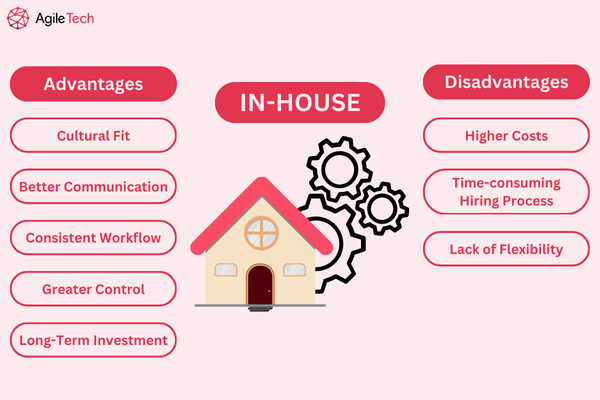
Advantages and Disadvantages of In-House Development
Advantages of In-House Development:
Cultural Fit: The in-house team understands your company culture and values. This helps the development align with the objective that the company is aimed at.
Better Communication: Your In-House team works on-site so you can have immediate discussions and avoid misunderstandings and delays.
Consistent Workflow: All your team members are full-time committed to your project. They will be more focused on the project and raise the team’s overall performance.
Greater Control: You can directly control every aspect of the development process and make immediate adjustments as needed.
Long-Term Investment: Building an in-house team can be a valuable long-term investment for your business. As your team works on more projects, they will gain a better understanding of your company culture and values. This ensures consistency across the projects.
Disadvantages of In-House Development:
Higher Costs: Building an in-house team will need a higher cost compared to outsourcing. Some costs you need to know include hiring, training, infrastructure, etc. Don’t forget that a team also needs a working space, equipment for their job, and financial investment from you.
Time-consuming Hiring Process: It may take you a lot of time to find the right person for your team.
Lack of Flexibility: This can be a problem when your team may not meet the project’s expertise requirements, or when you want to scale up your company, you will need more developers for your company’s increased workload. However, hiring new team members will take time for hiring and training, which will also put a strain on your current team.
1.3. When to Choose In-House Development
If your software development project needs continuous support or updates, an in-house team will be the better choice for you in terms of faster response and better communication.
If you have no budget constraints, building your own development team with high expertise will be better for your company’s long-term development.
Setting up an in-house team will be a more secure option if your company has a higher demand for data privacy and security, especially proprietary technology.
For companies that need deep connections among departments, having an in-house team guarantees consistent workflow.
2. Outsourcing Development Overview
Outsourcing Software Development
2.1. What is Outsourcing Development?
Outsourcing development is the practice of hiring external teams or companies to develop software projects instead of relying solely on an in-house team.
An outsourced development team can manage a variety of tasks for your company, starting with software development. They design, develop, and deploy applications tailored to your specific needs. They are also in charge of quality assurance and project management.
2.2. Advantages and Disadvantages of Outsourcing Development
Let’s take a look at the Advantages and Disadvantages of Outsourcing Development:
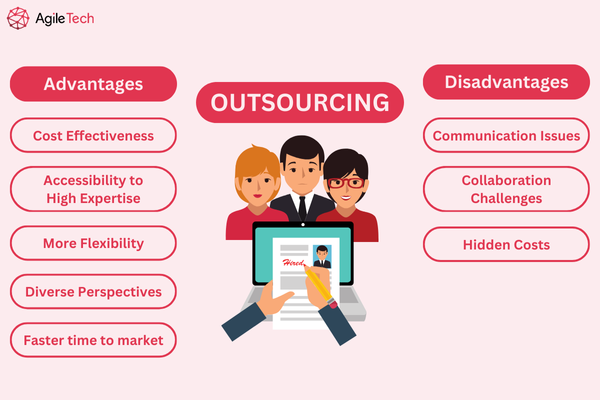
Advantages and Disadvantages of Outsourcing Development
Advantages of Outsourcing Development:
Cost Effectiveness: Outsourcing a developer team can help your business in reducing hiring and training costs, as well as infrastructure and equipment costs. Besides,outsourcing from countries with lower labor costs like Vietnam can help your business save money but still get high-quality products.
Accessibility to High Expertise: Employing external experts may enable you to access high technological expertise since you can not only outsource local developers but also global developers.
More Flexibility: When you choose to outsource a developer team, you can choose your team size, which is varied in different projects. You can also choose which developers in your team, which means you can pick the developers specialized in your business industry.
Focus on Core Business: Outsourcing allows your internal team to concentrate on core business functions while leaving technical tasks to experts.
Diverse Perspectives: Working with teams from different backgrounds and cultures can bring new ideas to your projects.
Faster time to market: Even if you have already had an in-house team, you can still outsource developers for faster development. Besides, you can also utilize the difference in time zone for 24/7 development.
Disadvantages of Outsourcing Development:
Collaboration Challenges: When you outsource a remote team, you may meet some problems due to differences in language, time zone, payment method, etc.
Communication Issues: Outsourcing a remote team means they may not always be at your office as an in-house team. Most discussion is done online, which may hinder immediate decision-making.
Hidden Costs: While outsourcing can save money, there may be hidden costs related to legal and compliance fees, communication tools, or unforeseen complications. You can clarify this with your outsourcing partners for better cost control.
Consult industry specialists
Connect with us today to discuss your software development needs and discover how our tailored outsourcing services can propel your business forward.